
Land
The role of due diligence in property transactions
TESA · July 31, 2026 · 16 min read

The role of due diligence in property transactions

Due diligence is the buyer’s verification process that turns an accepted offer into a defensible decision. It is the systematic investigation, run after a Purchase and Sale Agreement (PSA) is signed, that tests every assumption made during underwriting against actual documents, inspections, and third-party reports. The output is always one of three things: proceed, renegotiate, or walk away.
For Canadian buyers, this matters more than in many other markets. Under the principle of caveat emptor, the burden to discover defects generally rests with the buyer, not the seller. Documented, independent investigations and clear PSA contingencies are the primary legal protections available before closing.
The core protections due diligence delivers:
- Title clarity: confirms ownership is clean, free of hidden liens, encumbrances, or competing claims
- Financial validation: verifies that income, expenses, and tax obligations match what the seller represented
- Physical risk identification: surfaces structural defects, deferred maintenance, and environmental liabilities before they become the buyer’s problem
After a PSA is executed, the first calls to make are to a real estate lawyer (to order a title search through the provincial land-title or registry office) and a qualified building inspector or engineer. For any commercial or income-producing property, a Phase I Environmental Site Assessment should be ordered at the same time.
Table of Contents
- What does due diligence actually cover?
- What legal due diligence should you run on a property?
- How do you validate the financials on an income property?
- What physical inspections does a property need?
- When does due diligence happen, and what does it cost?
- What red flags should stop a deal in its tracks?
- Who pays for due diligence, and what clauses protect you?
- What Canadian-specific issues do you need to check?
- TESA’s practitioner checklist for Canadian investors
- Key takeaways
- TESA makes feasibility and due diligence faster for GTA investors
- Authoritative Canadian sources and further reading
What does due diligence actually cover?
Due diligence is a comprehensive, post-contract investigation used to verify financial performance, physical condition, and legal standing. It organises into three streams, each with its own specialists and deliverables.

| Pillar | Core checks | Typical specialists |
|---|---|---|
| Legal | Title search, liens, easements, zoning, permits, condo documents | Real estate lawyer, municipal planning office |
| Financial | Rent roll, operating statements, tax arrears, service contracts, financing | Accountant, mortgage broker |
| Physical | Building condition, structural, HVAC, electrical, plumbing, environmental | Home inspector, structural engineer, environmental consultant |
A comprehensive due-diligence package covers all three pillars simultaneously. Skipping one in favour of speed is where most costly surprises originate. The legal stream answers whether you can own and use the property as intended. The financial stream answers whether the numbers actually work. The physical stream answers whether the asset is what it appears to be.
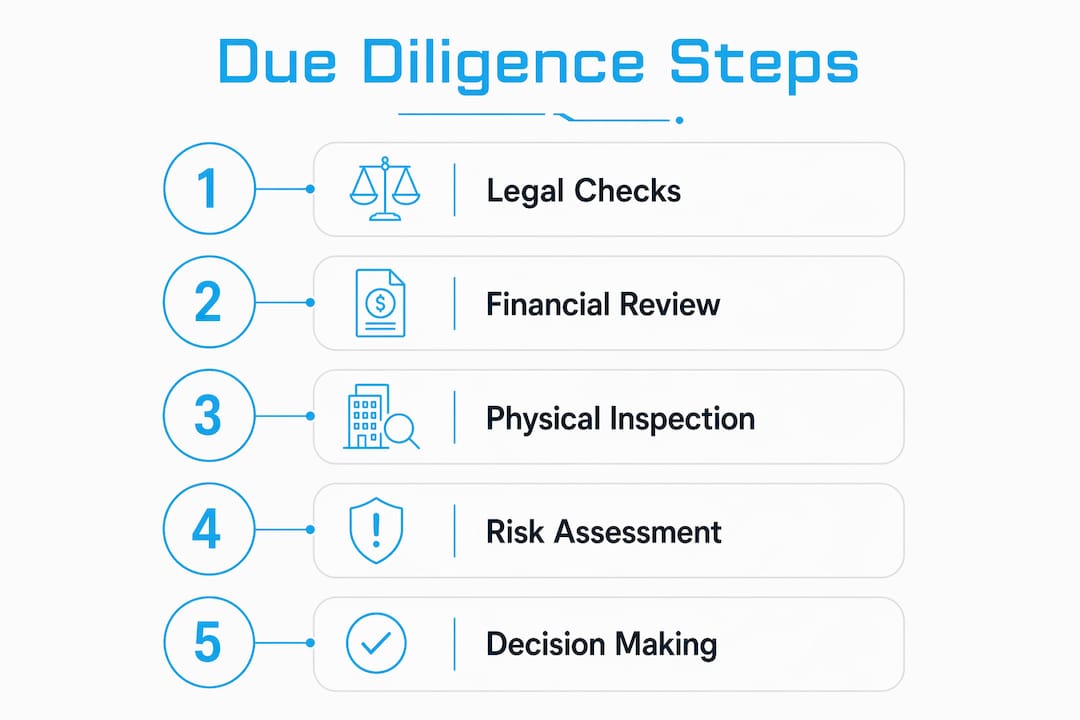
Appraisals answer a different question entirely: what a lender will lend against. They do not replace due diligence, and treating them as equivalent is a common and expensive error.
What legal due diligence should you run on a property?
Legal due diligence is the foundation. A clean title and clear permitted use are prerequisites for everything else, and problems here can be deal-breakers that no price adjustment fixes.
A property due diligence checklist for legal items should include:
- Title search: confirms the seller has clear ownership and reveals registered mortgages, judgments, or other claims against the property
- Liens and encumbrances: construction liens, tax liens, or utility arrears that could survive a sale and attach to the new owner
- Easements and rights-of-way: utility corridors, drainage easements, or access rights that restrict how the land can be used or developed
- Municipal zoning and permitted use: confirms the current use is legal and that any intended use (adding a suite, operating a business) is permitted under the applicable zoning by-law
- Building permits and code compliance: outstanding or unpermitted work can trigger orders to comply, remediation costs, or insurance refusals
- Condominium or strata documents: status certificate, reserve fund study, meeting minutes, and any pending special assessments for condo purchases
Title insurance and a title search serve related but distinct purposes. A title search, conducted by your lawyer through the provincial registry, reveals what is currently registered against the property. Title insurance protects against losses from defects that a search might miss, including fraud or errors in public records. Both are worth having; neither replaces the other.
Unexpected title issues are more common than most buyers expect, and environmental remediation costs can be substantial, which is why specialist work beyond a standard appraisal is necessary.
Pro Tip: Engage a real estate lawyer before signing the PSA, not after. Pre-signature advice on clause language, contingency periods, and document delivery requirements costs far less than renegotiating a poorly structured agreement under time pressure.
How do you validate the financials on an income property?
Financial due diligence for an income-producing property starts with one question: do the numbers the seller presented actually exist in the bank statements? The gap between a proforma and reality is where deals go wrong.
Documents to request from the seller:
- Rent roll (current, with lease expiry dates and any arrears)
- Trailing 12-month profit and loss statement
- Property tax bills and any outstanding tax arrears
- Utility bills (gas, hydro, water) for at least two years
- Service and maintenance contracts (elevator, HVAC, landscaping, snow removal)
- Existing mortgage details, including any prepayment penalties
- Tenant estoppel letters for commercial assets, confirming lease terms directly from tenants
The practical verification work involves cross-referencing the rent roll against actual bank deposit records, running a variance analysis on expenses to identify anything that looks suppressed or inconsistent, and confirming there are no special assessments or local improvement charges registered against the property.
What verified figures do to the deal is straightforward. If income is lower than represented, the asset is worth less than the agreed price. The buyer’s options at that point are a price adjustment, an escrow holdback pending resolution, or termination of the agreement. Lenders also rely on verified operating statements to confirm financing assumptions, so discrepancies affect not just valuation but whether the deal closes at all.
For landlords managing ongoing rental properties, a structured annual rental property review provides a useful framework for the kind of operational tracking that makes financial due diligence faster and more reliable.
What physical inspections does a property need?
Physical due diligence covers the condition of everything you cannot see from a listing photo. A general home inspection is the minimum for residential purchases; commercial and income properties require a broader scope.
A thorough inspection program covers:
- General property condition and deferred maintenance
- Structural integrity (foundation, load-bearing walls, framing)
- Roofing (age, condition, remaining useful life)
- HVAC systems (furnace, air conditioning, ventilation, age and service records)
- Electrical (panel capacity, wiring type, code compliance)
- Plumbing (supply lines, drainage, water heater)
- Life-safety systems (fire suppression, alarms, emergency egress)
- Site drainage and grading
For commercial properties, or any site with a history of industrial use, gas station operation, or dry cleaning, a Phase I Environmental Site Assessment (ESA) is standard practice. A Phase I reviews historical records, aerial photographs, and site conditions to identify potential contamination. If the Phase I identifies a Recognised Environmental Condition (REC), a Phase II ESA follows, involving soil and groundwater sampling to quantify the actual risk. Failing to complete environmental checks can leave buyers liable for remediation costs that were the seller’s problem before closing.
Decision guidance when findings come in:
- Remediation before close: typically applies to active safety hazards or code violations the seller agrees to fix as a condition of closing
- Price credit or escrow holdback: used when a deficiency is quantifiable but the seller will not repair it; funds are held back from sale proceeds until work is completed or costs are confirmed
- Walk away: appropriate when structural defects are severe, environmental contamination is unquantified, or the cost of remediation exceeds any reasonable price adjustment
A move-in inspection checklist is also worth reviewing when taking over a tenanted property, since it documents baseline condition and protects against future disputes with existing tenants.
When does due diligence happen, and what does it cost?
Meaningful buyer due diligence begins after a PSA is signed and runs to defined contingency deadlines negotiated in the agreement. Conducting serious investigation before a signed contract is generally impractical, since sellers rarely grant access or share sensitive financial documents without a binding agreement in place.
Timeline differences between property types:
- Residential purchases typically carry shorter due-diligence windows, often measured in days to a few weeks, covering title, inspection, and financing confirmation
- Commercial and income-producing properties commonly require 30–90 days or more, with multi-discipline investigations running in parallel across legal, financial, and physical streams; complex assets with environmental concerns or multiple tenants can require longer windows still
The single most common due-diligence mistake is accepting a timeline that is too short for the asset’s complexity. Negotiate realistic periods in the PSA before signing, not after.
Cost categories to budget for:
- Legal fees (title search, document review, PSA advice)
- Building inspection and specialist reports (structural engineer, roofing consultant)
- Phase I and, if triggered, Phase II ESA
- Survey and title work
- Accountant or financial analyst fees for income-property review
- Title insurance premium
- Contingency for unexpected follow-up investigations
What red flags should stop a deal in its tracks?
Red flags in due diligence are findings that change the risk profile of the asset materially. Some are fixable with the right structure; others are reasons to walk.
Common red flags and typical buyer responses:
- Unclear title or hidden liens: requires resolution before any close; a seller who cannot deliver clear title cannot complete the transaction
- Major structural defects: foundation failure, significant framing issues, or evidence of ongoing movement; typically triggers an engineering report and either a substantial price reduction or termination
- Unpermitted work: additions, basement suites, or electrical work done without permits; buyer inherits the liability unless the seller obtains retroactive permits or the price reflects the risk
- Serious environmental concerns: underground storage tanks, soil staining, or regulated materials; a Phase II is mandatory before any decision, and unquantified contamination is a common deal-breaker
- Tenants not paying rent: arrears that are not disclosed upfront, or tenants in dispute with the seller; buyers inherit existing tenancy relationships under Ontario’s Residential Tenancies Act and most provincial equivalents
- Zoning non-compliance: the current use is not permitted under the applicable zoning, or an intended use (adding a unit, operating commercially) is not achievable without a variance or rezoning
Inspection findings are among the most common reasons deals do not close, which is why a thorough inspection scope, not a cursory walk-through, is worth the cost.
Investors who treat due-diligence findings as negotiating material rather than just a pass/fail test often secure better outcomes. A documented deficiency is leverage: a price credit, a seller-funded repair, or a holdback from proceeds. The key is having findings in writing, from qualified professionals, before the contingency deadline expires.
Who pays for due diligence, and what clauses protect you?
Cost allocation in Canadian real estate transactions follows general market practice, though specifics vary by province and deal type.
Typical payment responsibilities:
- Buyer pays: building inspections, ESAs, structural or specialist reports, survey (if required), accountant fees for income-property review, title insurance premium
- Shared or negotiated: legal fees for title search and closing are typically the buyer’s cost; transfer taxes and registration fees vary by province and are generally the buyer’s responsibility
- Seller may be asked to pay: retroactive permits for unpermitted work, remediation of disclosed defects, or credits in lieu of repairs
Clause types to discuss with your lawyer when structuring the PSA:
- A clearly defined due-diligence period with a specific expiry date and time
- Right-to-terminate language that allows the buyer to exit within the contingency period without penalty if findings are unsatisfactory
- Document delivery requirements specifying what the seller must provide and by when (rent roll, operating statements, existing reports, service contracts)
- Escrow or holdback mechanics for deficiencies identified during due diligence, including the amount, release conditions, and deadline
- Financing contingency language tied to lender approval, not just application
On negotiation strategy: findings from due diligence are most effective when presented in writing, with professional reports attached, before the contingency deadline. A verbal concern carries little weight; a written engineer’s report with a repair estimate is a concrete basis for a price adjustment or a seller remedy. Buyers who document everything and communicate through counsel protect both their deposit and their negotiating position.
What Canadian-specific issues do you need to check?
Canada’s property transaction framework is jurisdictional. Land-title registration, environmental oversight, and municipal zoning authority all sit at the provincial or municipal level, and the rules differ meaningfully across provinces.
- Provincial land-title or registry system: British Columbia uses the Torrens title system through the Land Title and Survey Authority (LTSA); Ontario uses the Land Registry Office system under Teraview; Quebec operates under a civil law notarial system. Each has different search procedures and title insurance conventions.
- Provincial environmental agencies: the Ontario Ministry of the Environment, Conservation and Parks (MECP) maintains records of contaminated sites and environmental orders; equivalent bodies exist in each province. Check for any orders or records of site assessment on the subject property.
- Municipal planning office: zoning by-laws, official plan designations, development applications, and local improvement charges are held at the municipal level. For Toronto properties, the City of Toronto’s planning portal and planning map are starting points for zoning verification.
- CMHC: for financing context, CMHC’s resources on insured mortgage eligibility, property standards, and rental housing programs are relevant for buyers using insured financing. Specific program eligibility and thresholds should be confirmed directly with CMHC or a qualified mortgage broker.
- Conservation authority designations: properties near watercourses, wetlands, or floodplains in Ontario may be subject to Conservation Authority jurisdiction, which can restrict development, grading, or even certain renovations. Check with the relevant Conservation Authority before assuming development potential.
For buyers assessing land for development, entitlement risk, rezoning timelines, and municipal official plan policies are additional layers that a standard residential checklist does not capture.
Provincial variance also affects how caveat emptor applies in practice. Quebec’s civil law framework includes seller disclosure obligations that differ from common law provinces. In Ontario and most common law provinces, the buyer’s obligation to investigate is the primary protection, which is why independent professional reports matter so much.
TESA’s practitioner checklist for Canadian investors
For development-focused acquisitions in the Greater Toronto Area, the sequence of due-diligence tasks matters as much as the tasks themselves. Gating decisions early prevents wasted spend on later-stage investigations for assets that should have been screened out at the first step.
Priority order for the due-diligence window
| Priority | Task | Why it gates the deal |
|---|---|---|
| 1 | Title search | Confirms ownership and reveals any encumbrances that could prevent closing |
| 2 | Tenant verification | Confirms existing leases, arrears, and any disputes before financial modelling |
| 3 | Environmental screen (Phase I ESA) | Identifies contamination risk that could make the asset unfinanceable or unsaleable |
| 4 | Structural inspection | Quantifies capital repair requirements that directly affect underwriting |
| 5 | Operating statement verification | Cross-checks seller’s income and expense claims against source documents |
| 6 | Zoning and permitted-use check | Confirms the intended use or development scenario is achievable under current by-laws |
| Ongoing | Insurance and insurability review | Confirms the property is insurable at a cost consistent with underwriting assumptions |
Sample feasibility memo outline
A feasibility memo translates due-diligence findings into a decision framework. It does not need to be long; it needs to be clear.
- Asset summary: address, property type, purchase price, intended use
- Legal findings: title status, encumbrances, zoning confirmation, permit issues
- Financial findings: verified income and expenses, variance from seller’s representations, tax and arrears status
- Physical findings: inspection summary, capital repair estimate, environmental status
- Risk register: ranked list of open issues with estimated cost or probability of impact
- Decision recommendation: proceed (with conditions), renegotiate (with specific asks), or terminate (with rationale)
Pro Tip: Package every finding with its supporting document before the contingency deadline. A price-reduction request backed by a signed engineer’s report and a repair estimate is a negotiation. A verbal concern is not. Escalate any finding that touches title, environmental liability, or structural integrity to counsel immediately, not at the deadline.
For investors building a development case, TESA’s apartment development feasibility service integrates zoning, financial modelling, and site assessment into a single report, which is the kind of output a feasibility memo should be built on.
Key takeaways
Due diligence is the buyer’s primary protection in a Canadian property transaction, and the three pillars of legal, financial, and physical investigation must all be completed before the contingency deadline expires.
| Point | Details |
|---|---|
| Due diligence follows the PSA | Meaningful investigation begins after a signed agreement, with contingency deadlines negotiated upfront. |
| Three pillars gate every deal | Legal, financial, and physical streams must all clear before proceeding; a gap in any one creates unquantified risk. |
| Inspection findings terminate deals | Inspection findings are among the most common reasons deals do not close, making thorough physical review worth the cost. |
| Findings are negotiating leverage | Documented deficiencies from qualified professionals support price adjustments, credits, or holdbacks. |
| TESA offers 24-hour feasibility | TESA’s feasibility service delivers initial development insights within 24 hours, helping investors gate decisions before committing. |
TESA makes feasibility and due diligence faster for GTA investors
Buyers who skip or rush due diligence in the Greater Toronto Area often discover the cost later, in the form of title disputes, environmental orders, or capital repairs that were never priced into the deal. TESA’s end-to-end development platform addresses exactly this gap. Rather than coordinating separate lawyers, inspectors, and planners independently, investors working with TESA get zoning screening, financial feasibility modelling, and site assessment integrated into a single process, with initial feasibility insights delivered within 24 hours of engagement.
TESA’s services relevant to the due-diligence and feasibility stage:
- Rapid feasibility reports that flag zoning, development potential, and financial viability before a buyer commits
- Zoning and municipal planning screening for GTA neighbourhoods, including multiplex and infill scenarios
- Development opportunity identification through TESA’s GTA listings and opportunities platform, where feasibility screening is built into the evaluation process
- Syndicated investment structures through the Syndicate Build program for investors who want pooled capital and managed development without carrying the full diligence burden alone
For first-time investors who want a structured approach to evaluating properties before buying, TESA’s House Hacking MasterClass covers feasibility, financing, and due-diligence fundamentals in a format built for the Canadian market. Contact TESA to request a feasibility review before your next offer.
Authoritative Canadian sources and further reading
These are the primary sources to consult when verifying specifics during a Canadian property transaction. Each serves a distinct purpose in the due-diligence process.
-
Provincial land-title and registry offices: the Land Title and Survey Authority (LTSA) in British Columbia, Teraview (Ontario Land Registry) in Ontario, and equivalent bodies in other provinces are where title searches are ordered and registered encumbrances are confirmed. Your lawyer accesses these directly, but understanding what they contain helps buyers ask the right questions.
-
Municipal planning offices and portals: zoning by-laws, official plan designations, active development applications, and local improvement charges are held at the municipal level. The City of Toronto’s planning portal is the starting point for any Toronto property; other municipalities maintain equivalent resources. Consult these before assuming any development or conversion scenario is achievable.
-
Provincial environmental agencies: Ontario’s Ministry of the Environment, Conservation and Parks (MECP) maintains the Environmental Site Registry, which records Phase I and Phase II ESAs filed for Ontario properties, as well as environmental orders and records of site condition. Equivalent registries exist in other provinces. Check the registry for the subject property’s address before ordering a Phase I.
-
CMHC (Canada Mortgage and Housing Corporation): CMHC’s website provides guidance on insured mortgage eligibility, property standards for insured financing, and rental housing programs. For investors using CMHC-insured financing, confirming current program requirements directly with CMHC or a qualified mortgage broker is necessary, since thresholds and eligibility criteria change.
-
Conservation Authorities: in Ontario, Conservation Authorities regulate development near watercourses, wetlands, and floodplains. The relevant Conservation Authority for the property’s watershed should be consulted whenever the site is near water or has any floodplain designation. Permits may be required for grading, construction, or even landscaping in regulated areas.
-
Phase I and Phase II ESA providers: Phase I ESAs in Canada are conducted in accordance with CSA Standard Z768 (Phase I Environmental Site Assessment). Phase II ESAs follow CSA Standard Z769. Confirm that any environmental consultant engaged is familiar with the applicable provincial standard and the MECP’s Record of Site Condition process in Ontario.
This article provides general information about due diligence in Canadian property transactions. It is not legal, financial, or environmental advice. Confirm current rules, thresholds, and requirements with a qualified real estate lawyer, accountant, or environmental consultant for your specific situation.