
Land
MLI Select multiplex financing: a developer's guide
TESA · August 3, 2026 · 20 min read

MLI Select multiplex financing: a developer’s guide

MLI Select is CMHC’s points-based mortgage loan insurance product for multi-unit rental projects. It rewards commitments to affordability, energy efficiency, and accessibility with higher leverage, longer amortization, and reduced premiums. At the top tier, up to 95% financing and amortizations up to 50 years are available, numbers that can fundamentally change whether a multiplex project pencils.
What MLI Select can unlock for your project:
- Higher loan-to-value ratios than conventional multi-unit lending
- Amortization periods well beyond the standard 25-year residential ceiling
- Premium discounts of 10%, 20%, or 30% depending on your points tier (50, 70, or 100+): confirm with your CMHC-approved lender exactly how the discount is calculated on your file
- Binding affordability, energy, and accessibility commitments that run 10-20 years
Immediate next steps for a developer:
- Confirm your project has at least five self-contained units (four is ineligible, no exceptions)
- Run a quick points gap analysis with your design and energy consultant to see which tier is reachable at what cost
- Confirm net worth, liquidity, and surety bond expectations with a CMHC-approved lender before committing to a design direction
- If your site is in the Greater Toronto Area, schedule a TESA feasibility assessment to model whether MLI Select improves your project’s viability before you spend on drawings
MLI Select is not a grant or subsidy. It is mortgage loan insurance, and the obligations it attaches to your property are real and binding. The financing benefits are substantial, but only if your project can meet the points requirements cost-effectively and you can carry the long-term commitments.
Table of Contents
- How does CMHC’s MLI Select points system work?
- Is your multiplex project eligible for MLI Select?
- What does CMHC mean by affordability under MLI Select?
- What energy requirements does MLI Select set for your project?
- What accessibility commitments earn points under MLI Select?
- How does construction financing work with MLI Select take-out?
- How do you apply for MLI Select and what documents does CMHC need?
- What does MLI Select financing actually look like for a multiplex?
- When does MLI Select make sense for a multiplex project?
- Practical implementation: from site to CMHC approval
- Key takeaways
- TESA’s role in your MLI Select project
- Useful sources and further reading
How does CMHC’s MLI Select points system work?
The program scores your project across three pillars: affordability, energy efficiency, and accessibility. Points from each pillar add up to a total, and that total determines which tier you land in.
Three tiers structure the incentives:
- 50 points: entry-level benefits, modest premium discount, moderate amortization extension
- 70 points: mid-tier benefits, larger premium discount, longer amortization
- 100+ points: top-tier benefits, maximum leverage, longest amortization, largest premium discount
Two variables affect your premium: extending amortization beyond the standard period typically adds a surcharge to the base premium, and reaching a points tier earns a discount (10%, 20%, or 30% at the respective tiers) on the premium. Exactly how the surcharge and the discount interact on a given file varies, so confirm the calculation with your CMHC-approved lender before you model the numbers. The net cost depends on how far you extend amortization and which tier you reach.
| Tier | Points required | Premium discount | Amortization potential |
|---|---|---|---|
| Entry | 50 | 10% | Extended beyond standard |
| Mid | 70 | 20% | Further extended |
| Top | 100+ | 30% | Up to 50 years |
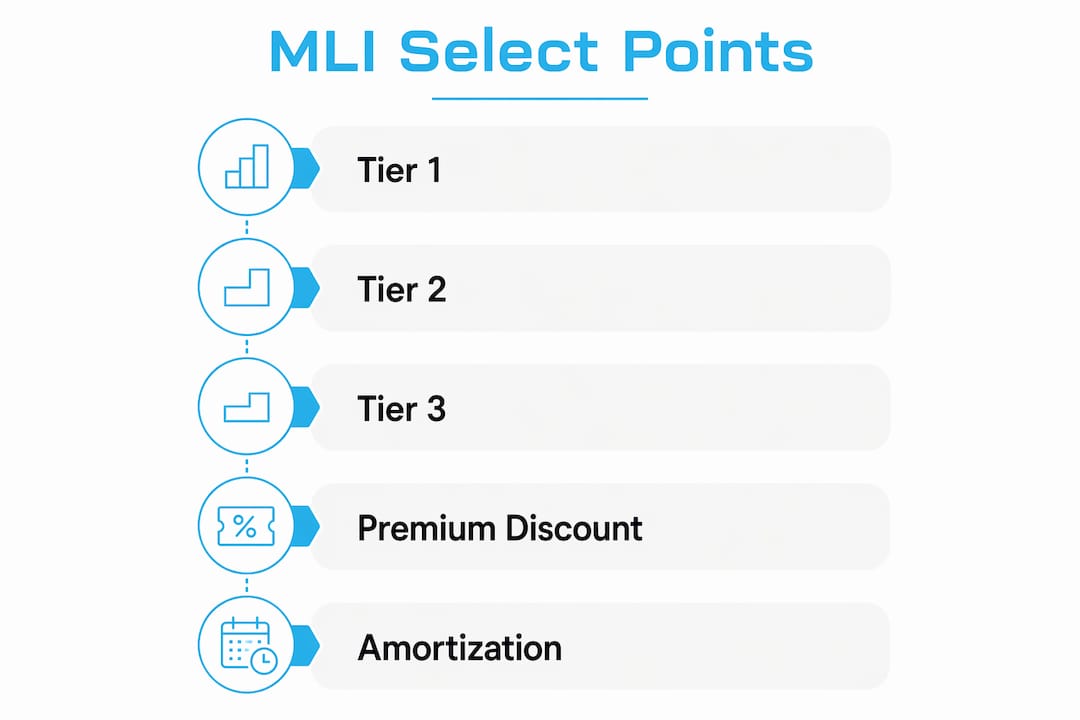
Source: CMHC MLI Select program descriptions. Confirm current thresholds and premium calculation details with CMHC or an approved lender.
Points by pillar, common examples:
- Affordability: committing a percentage of units at rents tied to area median renter income; longer commitment duration (20 years vs. 10) earns additional points
- Energy efficiency: meeting or exceeding National Energy Code for Buildings (NECB) benchmarks, achieving EnerGuide ratings, net-zero-ready design, or demonstrable retrofit performance improvements
- Accessibility: share of barrier-free units, visitable unit design, adaptable features aligned with CSA standard B651-23 or Rick Hansen Foundation Accessibility Certification v.4.0
For new construction, all three pillars are available. For existing buildings, the same pillars apply but point values and evidence requirements differ, particularly for energy retrofits where third-party verification of performance improvement is expected.
Pro Tip: The fastest path to 50 points for most new-build projects is a combination of modest affordability depth (a share of units at a rent threshold) and a credible energy target your designer can already hit with standard construction. Stacking all three pillars is not always necessary to clear the first tier, and the cost of over-committing on accessibility or energy can erode the cash-flow benefit you were trying to unlock.
Is your multiplex project eligible for MLI Select?
The hard gate is unit count. MLI Select requires a minimum of five self-contained residential units, and there are no waivers for that threshold. A four-unit project is simply ineligible. This is one of the most consequential early decisions in multiplex feasibility: moving from four to five units often changes the entire financing pathway and can be the difference between a project that fails a debt-service coverage ratio (DSCR) test and one that works.
Beyond unit count, the project must be purpose-built rental. For-sale strata or condominium tenure does not qualify. The program covers standard rental buildings, single room occupancies (SROs), supportive housing, retirement homes, and new construction or existing properties. Student housing projects qualify only under the energy efficiency and accessibility pillars, not affordability.
Pre-screening checklist:
- Five or more self-contained residential units (confirm this before any design work)
- Purpose-built rental tenure (not for-sale strata or condo)
- Borrower profile: CMHC will assess net worth, liquidity, and development experience; first-time developers should expect closer scrutiny and may need an experienced operator on the team
- Surety bond capacity if you intend to act as your own general contractor
- Site zoning that permits the intended unit count (check Toronto multiplex zoning rules for as-of-right permissions in the GTA)
If any of these items are uncertain, the right first call is to a CMHC-approved lender or a specialised mortgage broker with multi-unit experience. TESA can also confirm feasibility and points potential for GTA sites before you engage a lender. The official CMHC MLI Select program page and the program PDF are the authoritative sources for current eligibility rules.
What does CMHC mean by affordability under MLI Select?
Affordability under MLI Select is not a vague social commitment. It is a specific, measurable, and legally binding obligation tied to area median renter income (AMRI) data published by CMHC. Your project earns points by committing a defined percentage of units at rents at or below a threshold derived from that income data. The more units you commit, and the deeper the rent restriction, the more points you earn.
Commitment duration matters as much as depth. Affordability criteria apply for a minimum of 10 years, and borrowers who commit to 20 years receive an additional 30 points. That 30-point swing is significant: it can be the difference between the 50-point and the 100-point tier for some projects.
Common affordability levers:
- Percentage of units at a rent threshold tied to AMRI (higher percentage earns more points)
- Depth of the rent restriction relative to market rent
- Duration of the commitment (10 years minimum; 20 years earns the additional 30 points)
- New construction vs. existing: point values differ, so confirm the applicable table with your lender
For markets where CMHC does not have local renter income data, the program accepts data from comparable centres, provincial data, or comparable rural centres.
Pro Tip: Before locking your affordability commitment, model two scenarios side by side: one where you commit more units at a shallower rent discount, and one where you commit fewer units at a deeper discount. The points outcome can be similar, but the cash-flow impact over 20 years is very different. Weigh the rent restriction cost against the amortization and leverage gain at each tier, not just the points arithmetic. A sensitivity table showing net operating income under each scenario, stress-tested at a few vacancy rates, is the kind of analysis a CMHC-approved lender will want to see anyway.
What energy requirements does MLI Select set for your project?
Energy efficiency is the pillar where design decisions made early in the process have the biggest downstream impact on points. The commitments are technical, and they require third-party verification, so coordinating with your energy consultant before schematic design is locked is not optional.
Common energy pathways that earn points:
- Meeting or exceeding the National Energy Code for Buildings (NECB) or National Building Code (NBC) benchmarks at specified performance levels
- Alignment with provincial step codes where applicable (British Columbia’s Step Code is the most developed, but Ontario’s SB-12 energy requirements are also relevant for GTA projects)
- EnerGuide ratings or net-zero-ready design pathways
- For existing buildings: demonstrated energy performance improvement relative to a verified baseline, with third-party verification of the projected or achieved savings
New construction and existing retrofits are scored differently. A new build targeting a specific NECB performance tier earns points based on how far above the baseline it performs. A retrofit earns points based on the percentage improvement over the existing building’s verified energy consumption. CMHC expects an energy model prepared by a qualified energy modeller and, for retrofits, third-party verification of the performance claims.
The practical implication: if your architect or builder has not worked with energy modellers on CMHC submissions before, build that relationship early. Retrofitting energy targets after design development is expensive and often means redesigning mechanical systems. For GTA new-build projects, light steel framing methods can support tighter building envelopes that align with NECB performance targets, which is worth discussing with your design team at the concept stage.
What accessibility commitments earn points under MLI Select?
Accessibility is often the most underestimated pillar. Developers sometimes treat it as a compliance checkbox, but the points available here can meaningfully contribute to reaching a higher tier, particularly for new construction where accessible design is far less costly than retrofitting.
Features that commonly earn points:
- A defined share of units that are fully barrier-free, meeting CSA standard B651-23 or Rick Hansen Foundation Accessibility Certification (RHFAC) v.4.0 standards
- All units in the project being 100% visitable (meaning a person using a mobility device can enter and use a washroom on the main floor)
- All common areas being barrier-free in accordance with CSA B651-2023
- Adaptable design elements that allow units to be modified for accessibility needs without structural changes
For new construction, meeting visitability across all units and barrier-free common areas is the baseline expectation. Points are earned by going further: increasing the share of fully accessible units, achieving RHFAC certification, or incorporating universal design principles beyond the minimum.
For existing buildings, retrofitting for accessibility is more constrained by structure and layout. CMHC expects documentation showing which units have been upgraded, the standard applied, and third-party confirmation where certification is claimed.
Pro Tip: Coordinate accessibility upgrades with your unit mix strategy early. A building designed with wider corridors, no-step entries, and reinforced bathroom walls from the start costs a fraction of what it costs to retrofit those features later. If you are targeting the 70-point tier, adding two or three fully accessible units to a new-build design is often the lowest-cost way to close a points gap, compared to deepening affordability commitments or upgrading mechanical systems for energy.
How does construction financing work with MLI Select take-out?
MLI Select is a permanent mortgage insurance product, not a construction loan. Understanding that distinction is central to structuring your capital stack correctly from day one.

The typical sequence looks like this: equity and land financing cover acquisition, a construction loan funds the build in inspected draw stages, and then MLI Select permanent financing takes out the construction loan once the project is stabilised. Many development teams use a bridge-to-perm strategy: accept higher-cost construction financing during the build phase, then refinance to lower-cost MLI Select permanent financing when occupancy and income targets are met.
MLI Select differs from ACLP in an important way. ACLP (Affordable Construction Lending Program) is a construction bridging program that approves faster but requires a permanent take-out commitment. MLI Select is the permanent financing. Many teams use ACLP for construction and MLI Select for the permanent mortgage, which is a common and well-understood sequencing in the market.
Bridge-to-perm checklist:
- Confirm take-out triggers with your construction lender: typical stabilisation metrics include a defined occupancy rate and a minimum period of rent collection
- Coordinate the MLI Select application timeline with your construction schedule so underwriting is not holding up your take-out
- Ensure your construction lender and CMHC-approved lender are aligned on draw conditions, holdbacks, and the transition to permanent financing
- Budget for the gap between construction completion and stabilisation: carrying costs during lease-up are real and need to be in your pro forma
Borrower and guarantor obligations differ between stages. During construction, lenders typically require personal guarantees or limited recourse arrangements. When the developer acts as their own general contractor, CMHC expects surety bonds, specifically performance bonds and labour and material payment bonds, as third-party assurance of completion capacity. Established relationships with surety underwriters matter here: surety bond procurement is a common bottleneck that can delay an MLI Select timeline if left too late.
How do you apply for MLI Select and what documents does CMHC need?
The application process runs through a CMHC-approved lender, not directly through CMHC. Your lender submits on your behalf, which means the quality of your file and your lender’s familiarity with MLI Select both affect how smoothly underwriting goes.
Step-by-step application workflow:
- Pre-qualify with a CMHC-approved lender: Confirm your project’s basic eligibility (unit count, tenure, borrower profile) and get a preliminary read on which points tier is realistic.
- Points pre-assessment: Work with your design team, energy consultant, and lender to map your affordability, energy, and accessibility commitments against the points tables. Identify gaps and adjust design or commitment depth before spending on detailed drawings.
- Assemble your application file: This is where most delays happen. A complete file takes time to build, and rework is expensive.
- Lender submission to CMHC: Your lender packages and submits the file. CMHC underwrites the application, which includes reviewing the pro forma, the points evidence, and the borrower profile.
- CMHC approval and commitment letter: Once approved, CMHC issues a commitment. Conditions must be satisfied before the insurance certificate is issued.
- Ongoing compliance: Post-approval, you are bound by the affordability, energy, and accessibility commitments for their stated duration. CMHC monitors compliance.
Document checklist:
- Detailed pro forma and financial projections with credible rent and expense assumptions
- Leases and rent roll (for existing properties)
- Energy model prepared by a qualified energy modeller, with third-party verification where required
- Accessibility documentation: unit plans, design specifications, certification evidence if applicable
- Evidence of net worth and liquidity (CMHC sets expectations; confirm current thresholds with your lender)
- Bonding documents if the developer is acting as general contractor
- Construction contract and project schedule
- Site plan, building permits, and zoning confirmation
Successful applicants commonly engage specialised brokers early to assemble a CMHC-ready file. A broker who has submitted multiple MLI Select files knows what CMHC’s underwriters want to see and can prevent the kind of rework that adds months to a timeline. The CMHC MLI Select program PDF contains the official application checklist and documentation guidance; treat it as your primary reference.
What does MLI Select financing actually look like for a multiplex?
The financing mechanics are where the program’s value becomes concrete. Here is what developers typically see in the market.
Key financing implications:
- Higher loan-to-cost or loan-to-value ratios than conventional multi-unit lending, with up to 95% financing at the top tier
- Amortization periods up to 50 years at 100+ points, compared to the 25-year ceiling on most conventional residential loans
- Premium structure: a base premium, plus a possible surcharge for extended amortization, with a tier discount (10%, 20%, or 30%) reducing the premium at your points level; confirm the exact calculation with your CMHC-approved lender
- DSCR underwriting: lenders assess debt-service coverage ratio based on your pro forma income and expenses; longer amortization reduces monthly debt service, which directly improves DSCR and can make a project that fails conventional underwriting viable under MLI Select
The amortization extension is often the single most powerful lever. Spreading principal repayment over 40 or 50 years rather than 25 reduces monthly payments materially, which improves cash flow even when rents are partially restricted under an affordability commitment. Use a DSCR loan calculator to model how different amortization periods affect your debt coverage under various rent and vacancy assumptions before you finalise your points strategy.
Modelling tips:
- Present rent assumptions conservatively and tie them to verifiable market comparables; CMHC underwriters will scrutinise optimistic projections
- Model the net operating income under your affordability commitment, not just at market rents, to confirm DSCR holds at the restricted rent level
- Factor in the full insurance premium cost, including any amortization surcharge and your tier discount, in your total financing cost, not just the interest rate
| Program mechanic | Detail |
|---|---|
| Maximum leverage (top tier) | Up to 95% financing |
| Maximum amortization (top tier) | Up to 50 years |
| Premium discount at 50 pts | 10% |
| Premium discount at 70 pts | 20% |
| Premium discount at 100+ pts | 30% |
| Affordability commitment minimum | 10 years (20 years earns additional 30 points) |
All figures sourced from CMHC MLI Select program descriptions and Lendcity’s program guide. The premium discount percentages are set by CMHC; how a discount interacts with any amortization surcharge on a specific file should be confirmed with CMHC or an approved lender before modelling.
When does MLI Select make sense for a multiplex project?
The program is not the right fit for every project. The financing benefits are real, but so are the costs: the points commitments, the documentation burden, the surety requirements, and the binding long-term obligations. Here is a decision framework.
MLI Select tends to make sense when:
- Your project has five or more units and is purpose-built rental
- You can reach a meaningful points tier (50+) without commitments that erode the cash-flow benefit you are trying to unlock
- The extended amortization or higher leverage is the difference between a project that pencils and one that does not
- You have the development experience and team capacity to assemble a rigorous CMHC application file
- You are comfortable with 10-20 year affordability, energy, and accessibility obligations on the property
MLI Select tends to be a poor fit when:
- Your project is four units or fewer (simply ineligible)
- The cost of meeting points requirements (energy upgrades, accessible unit design, rent restrictions) exceeds the financing benefit
- You need fast financing and cannot accommodate CMHC’s underwriting timeline
- You are planning to sell the property in the near term and the binding obligations would complicate disposition
Illustrative scenarios:
A 6-unit new-build in Toronto where the developer can hit 50 points with modest affordability commitments and a standard energy target: the amortization extension alone can reduce monthly debt service enough to make the project viable where conventional financing would not. That is the program working as intended.
A 5-unit retrofit where reaching even 50 points requires expensive mechanical upgrades and deep rent restrictions: the points cost may exceed the financing benefit, and conventional financing with a shorter amortization might actually leave the developer with more flexibility and less long-term obligation.
For developers who need an independent model before committing to a design direction, TESA’s multiplex feasibility study service is built for exactly this kind of early-stage decision. A feasibility output that models MLI Select versus conventional financing side by side, with realistic cost and rent assumptions for the GTA, is the most efficient way to answer the question before spending on drawings.
Practical implementation: from site to CMHC approval
Getting from a site to a funded MLI Select project involves more moving parts than most developers expect the first time through. The sequencing matters as much as the individual steps.
Implementation workflow:
- Site selection and feasibility: Confirm zoning permits five or more units as-of-right or with achievable approvals. Run a preliminary feasibility model that includes MLI Select financing assumptions. TESA’s development feasibility service can deliver a fast output for GTA sites, helping developers decide whether to proceed before committing to due diligence costs.
- Design coordination: Lock energy targets and accessibility commitments before schematic design is finalised. Changes after design development are expensive. Bring your energy consultant into the design process at concept stage, not after permits.
- Construction procurement and bonding: If you are acting as your own general contractor, secure surety bond relationships early. Surety underwriters assess your financial capacity and track record; this is not a last-minute task. Delays in bonding are one of the most common reasons MLI Select timelines slip.
- Construction financing: Draw down your construction loan in inspected stages. Maintain detailed cost tracking and holdback management. Your construction lender will have draw conditions; meet them consistently to avoid delays.
- Lender coordination and CMHC submission: Engage your CMHC-approved lender well before construction is complete. The underwriting timeline for MLI Select is longer than conventional residential lending, and you want the commitment letter in hand before you need the take-out.
- Stabilisation and take-out: Once occupancy and income targets are met, trigger the take-out to MLI Select permanent financing. Coordinate with both lenders to avoid a gap in coverage.
Bridge-to-perm in practice: Construction financing is typically higher cost than permanent financing. The bridge-to-perm strategy accepts that cost during the build phase in exchange for the better long-term terms MLI Select provides. The key is not letting the construction phase run long: cost overruns and schedule delays during construction eat into the equity position you were counting on at take-out. Tight construction management and early procurement of long-lead items (mechanical equipment, structural steel) directly protect your MLI Select financing outcome.
TESA’s integrated model covers site finding, design, construction management, and capital structuring in one engagement. For developers pursuing MLI Select financing in the GTA, having the feasibility, design, and construction teams coordinated from the start reduces the rework and timeline risk that typically inflate costs on CMHC submissions. TESA’s Syndicate Build program also offers a structured capital option for developers who need to strengthen the equity side of the capital stack.
Pro Tip: The single most common reason MLI Select applications stall is an incomplete or inconsistent file: a pro forma that does not reconcile with the rent roll, energy evidence that does not match the design drawings, or net worth documentation that is out of date. Assign one person on your team to own the application file from the points pre-assessment through to CMHC submission. That person’s job is to make sure every document is current, consistent, and formatted the way CMHC expects.

Key takeaways
MLI Select is the most powerful financing tool available for Canadian multiplex developers, but only for projects that can meet the points requirements cost-effectively and carry the long-term obligations.
| Point | Details |
|---|---|
| Five-unit minimum is a hard gate | Projects with fewer than five self-contained units are ineligible, with no exceptions. |
| Points tiers unlock real financing gains | 50, 70, and 100+ points tiers carry premium discounts of 10%, 20%, and 30%, plus progressively longer amortization up to 50 years. Confirm the exact premium calculation with CMHC or an approved lender. |
| Affordability commitments are binding | Minimum 10-year obligation; committing to 20 years earns an additional 30 points and changes tier outcomes materially. |
| Bridge-to-perm is the standard approach | Most teams use construction financing during the build, then refinance to MLI Select permanent financing once the project is stabilised. |
| TESA supports GTA projects end to end | TESA’s feasibility, design, construction, and capital services are structured to align with each stage of an MLI Select application. |
Post-approval, your affordability, energy, and accessibility commitments are legally binding for their stated duration. CMHC monitors compliance, and failing to meet those obligations carries real consequences for the property and the borrower.
TESA’s role in your MLI Select project
MLI Select financing rewards preparation. The developers who get through CMHC underwriting without costly rework are the ones who locked their points strategy before design, secured surety relationships before procurement, and had a credible pro forma from day one.
TESA brings feasibility, design, construction, and capital structuring together for multiplex projects in the Greater Toronto Area. Where most development engagements treat those as separate mandates, TESA coordinates them from site selection through to CMHC submission, which means your energy targets, accessibility commitments, and pro forma assumptions are consistent across every document in your application file. TESA’s development feasibility service delivers fast outputs for GTA sites, including a preliminary MLI Select points gap analysis, so you can decide whether the program improves your project’s viability before committing to drawings or due diligence costs. For developers who want to build their own capacity alongside a live project, TESA’s education programs cover the full multiplex development process, including CMHC financing mechanics. To get a fast feasibility read on your site, contact TESA at tesa.group/feasibility.
Useful sources and further reading
The sources below are the authoritative references for MLI Select program mechanics, eligibility, and application requirements. Confirm all numeric thresholds and program details directly with CMHC or an approved lender, as program parameters are updated periodically.
- MLI Select program page (CMHC): The official CMHC program page covering eligibility, the points system, affordability, energy, and accessibility criteria. Start here.
- MLI Select program PDF (CMHC): The full program document with points tables, insurance flexibilities, application checklist, and documentation requirements. The definitive reference for application preparation, including exactly how premium discounts are calculated.
- Multi-unit mortgage loan insurance overview (CMHC): Broader context on CMHC’s multi-unit insurance products, including how MLI Select fits alongside other programs.
- Surety bonds and MLI Select (NFP): Practical guidance on surety bond requirements for developer-builders under MLI Select, including what CMHC expects and how to avoid bonding delays.
- MLI Select for multiplex (VanPlex): A developer-focused explainer covering the points tiers, premium structure, and affordability commitment mechanics.
- MLI Select guide (Lendcity): Covers leverage, amortization, and the ACLP-to-MLI-Select sequencing in accessible terms for developers and investors.
- Multiplex financing and MLI Select (RenoHouse): Toronto-focused overview of bridge-to-perm strategies and construction financing sequencing for MLI Select projects.
- TESA MLI Select guide for Toronto multiplex owners: TESA’s local perspective on MLI Select for GTA projects, including feasibility and points strategy considerations.
This article is general information for educational purposes. It is not professional financial, legal, or mortgage advice. Confirm current program rules, eligibility thresholds, and financing terms, including exactly how premium discounts are calculated, with CMHC directly or with a qualified CMHC-approved lender for your specific project.