
Land
What is construction management: roles, phases, and process
TESA · July 13, 2026 · 9 min read
What is construction management: roles, phases, and process
Construction management is defined as a professional service that applies planning, design, and project management techniques to control scope, time, cost, and quality across the full lifecycle of a construction project. Known formally in the industry as construction project management, it covers three distinct phases: pre-construction, construction execution, and post-construction. Each phase carries its own responsibilities, from early feasibility and budgeting through to site safety, scheduling, and final handover. Getting this coordination right is what separates projects that close on time from those that drain capital for months past their deadline.
What is construction management and how does it work?
Construction management is a systematic professional service applying planning, design, and project management techniques to control scope, time, cost, and quality across a project lifecycle. The discipline is not limited to the physical act of building. It begins at the earliest stages of a project and continues through final occupancy.
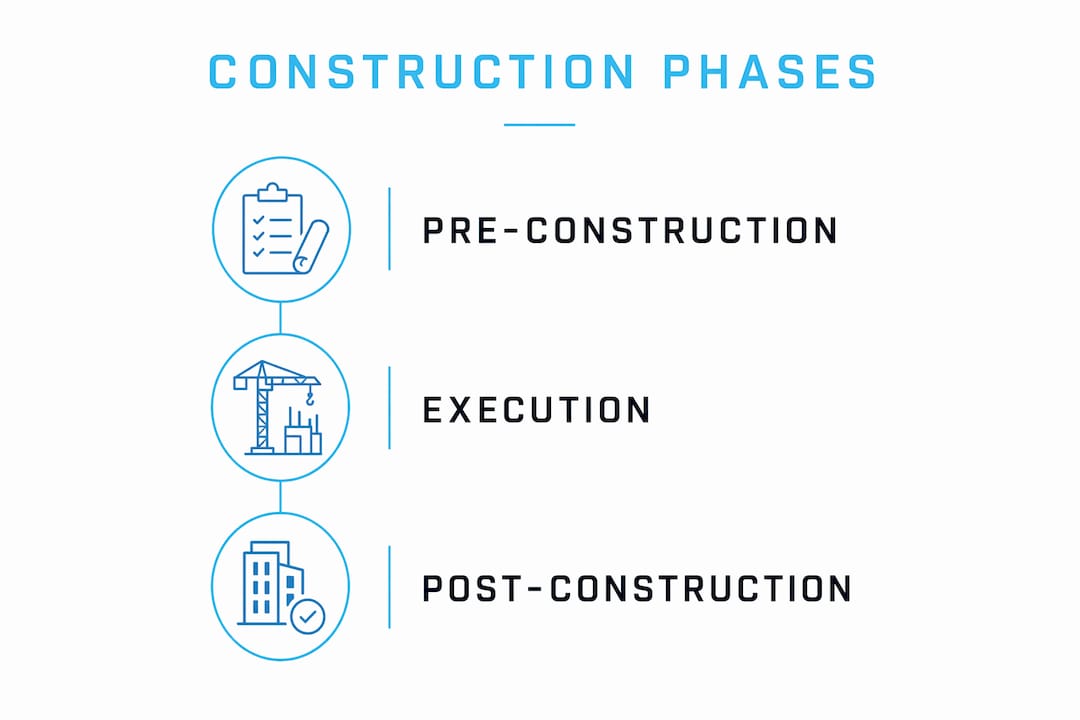
The process is built around three sequential phases. Pre-construction covers planning, feasibility analysis, design coordination, and procurement strategy. Construction execution handles on-site scheduling, labour coordination, safety compliance, and quality control. Post-construction addresses documentation, snag-list resolution, regulatory approvals, and client handover. Each phase feeds directly into the next, so a weakness in pre-construction planning compounds into delays and cost overruns during execution.
The project management triangle sits at the centre of every decision in this discipline. Scope, time, and cost are interdependent constraints. Expanding scope without adjusting time or budget breaks the triangle and puts the project at risk. Successful construction management means balancing these constraints without sacrificing quality or safety.
What are the main phases of construction management?
Each phase of a construction project has a distinct purpose and a defined set of activities. Treating them as separate but connected stages is what allows experienced teams to anticipate problems before they become crises.
| Phase | Key activities | Primary goal |
|---|---|---|
| Pre-construction | Feasibility studies, budgeting, design coordination, procurement planning | Validate viability and set the project baseline |
| Construction execution | Scheduling, site safety, subcontractor management, quality control | Deliver the build on time and within budget |
| Post-construction | Snag-list completion, documentation, final approvals, client handover | Close the project cleanly and release capital |
Pre-construction is where the most value is created. Construction managers contribute expertise during design and feasibility to save time and capital before a single shovel breaks ground. Buildability reviews at this stage catch design conflicts that would otherwise surface mid-build at far greater cost.
Construction execution is the most visible phase, but it is the most reactive if pre-construction was weak. On-site managers coordinate subcontractors, track daily progress against the schedule, enforce safety protocols, and escalate issues before they cascade. Quality control checkpoints happen continuously, not just at the end.
The post-construction phase prioritizes documentation, snag-list resolution, and securing final approvals to avoid delayed project close-out that ties up capital. Experienced teams treat handover as a structured process, not an afterthought. Meticulous documentation at this stage protects all parties and enables timely occupancy.
Pro Tip: Start building your snag list during construction execution, not after practical completion. Teams that track deficiencies in real time close out projects weeks faster than those who compile the list at the end.
What are the roles and responsibilities in construction management?
The most common source of confusion in construction project management is the distinction between a project manager and a construction manager. These are not interchangeable titles. They describe fundamentally different functions.
A project manager's focus is administrative and contractual: budgeting, contract negotiation, scheduling, and overall coordination from site selection through to handover. A construction manager works in the field. Their focus is operational: day-to-day site execution, safety compliance, subcontractor direction, and resolving immediate site issues. Project managers and construction managers work in tandem rather than isolation to meet project objectives.
Supporting roles fill critical gaps that neither manager can cover alone:
- Scheduler: Builds and maintains the project schedule, tracks the critical path, and flags delays before they affect the completion date.
- Estimator: Produces cost forecasts during pre-construction and monitors budget variance throughout the build.
- Safety officer: Enforces occupational health and safety regulations on site, conducts inspections, and manages incident reporting.
- Site engineer: Provides technical oversight, interprets drawings, and resolves design conflicts in the field.
- Contract administrator: Manages subcontractor agreements, change orders, and payment certifications.
On large projects, these roles report through a defined hierarchy. The construction manager reports to the project manager, who reports to the project owner or their representative. Clear reporting lines prevent decisions from stalling when site conditions change.
Pro Tip: On mid-size projects where budget does not support a full team, the scheduler and estimator functions are often combined. Assign this responsibility explicitly rather than assuming it falls under the project manager’s remit.
Why is construction management important?
Professional construction management reduces risk. Without it, projects routinely exceed budgets, miss deadlines, and produce work that fails quality or safety standards. The discipline exists precisely because construction is complex, multi-party, and time-sensitive.
The core goal is balancing the project management triangle: scope, time, and cost, without compromising quality or safety. This sounds straightforward. In practice, it requires constant decision-making across dozens of variables simultaneously.
The concrete benefits of professional construction management include:
- Risk reduction: Proactive planning identifies risks before they become site problems, reducing the frequency and cost of reactive fixes.
- Budget control: Continuous cost tracking against the approved budget catches overruns early, when corrective action is still possible.
- Schedule adherence: Critical path monitoring keeps the team focused on activities that directly affect the completion date.
- Quality assurance: Structured inspection and sign-off processes prevent defects from being buried inside finished work.
- Safety compliance: Formal safety management reduces liability and protects workers, which also protects the project from regulatory shutdowns.
- Stakeholder alignment: Regular reporting and structured communication keep owners, architects, engineers, and subcontractors working toward the same outcome.
Effective communication systems are often the backbone of successful construction management. Without them, even detailed schedules and budgets risk failure during project execution. A project can have a perfect plan on paper and still collapse if the team cannot communicate clearly when conditions change.
What processes and tools support effective construction management?
Modern construction project management relies on a combination of structured methodologies and practical tools. Neither alone is sufficient. Methodology without tools creates administrative overhead. Tools without methodology create data without direction.
The critical path method (CPM) is the most widely used scheduling framework in the industry. It identifies the sequence of tasks that determines the project’s minimum completion time. Any delay to a critical path task delays the entire project. Managers use CPM to prioritize resources and make informed trade-off decisions when schedules are compressed.
- Project scheduling software: Digital scheduling tools allow managers to build Gantt charts, assign resources, and track progress against the critical path in real time.
- Budget tracking systems: Cost management platforms compare actual expenditure against approved budgets at the line-item level, enabling early variance detection.
- Document management platforms: Centralized document control ensures all parties work from current drawings and specifications, reducing errors caused by outdated information.
- Safety management tools: Digital inspection checklists and incident reporting systems create an auditable safety record across the project lifecycle.
- Communication platforms: Structured communication tools log decisions, track requests for information (RFIs), and maintain a clear record of stakeholder approvals.
Project management software monitors milestones, critical path dependencies, and resource allocation, helping keep projects on or under budget. The shift from paper-based to digital project management has significantly reduced the time teams spend searching for information and reconciling conflicting versions of documents.
Procurement strategy is another process that directly affects project outcomes. Locking in subcontractor agreements and material supply contracts during pre-construction reduces exposure to price escalation and availability gaps during execution. Teams that treat procurement as an afterthought consistently face mid-build delays.
What challenges do construction managers face?
Construction management is demanding because the variables are never fully within the manager’s control. Site conditions change. Supply chains break. Regulatory requirements shift. The discipline requires both structured planning and the ability to adapt quickly.
The most common challenges include:
- Scope creep: Owners and designers introduce changes after construction begins, which disrupts schedules and inflates costs without a formal change management process.
- Supply chain disruption: Material shortages and delivery delays push critical path tasks back, compressing later phases of the schedule.
- Weather and site conditions: Unexpected ground conditions or severe weather create unplanned costs and schedule extensions that require immediate replanning.
- Regulatory compliance: Building code requirements, occupational health and safety regulations, and municipal approvals add complexity that must be managed proactively.
- Stakeholder conflict: Architects, engineers, subcontractors, and owners frequently have competing priorities. Resolving these conflicts without derailing the project requires structured communication and clear authority.
Communication and conflict resolution mechanisms are fundamental for managing complex stakeholder relationships and preventing project failures. Managers who document decisions and maintain transparent reporting are far better positioned to resolve disputes quickly than those who rely on informal agreements.
The most effective response to these challenges is proactive planning. Teams that invest in detailed pre-construction analysis, including development feasibility studies, identify risks before they become site emergencies. Reactive management is always more expensive than prevention.
How TESA applies construction management in real estate development
TESA is a bespoke real estate development company operating in the Greater Toronto Area. Its model integrates the full construction management lifecycle, from site finding and feasibility through design, build, and funding, into a single coordinated service. That integration is what makes TESA’s approach distinct from firms that treat each phase as a separate engagement.

TESA’s development services apply structured construction management principles at every stage, including pre-construction feasibility analysis that delivers initial insights within 24 hours. For investors and developers who want direct exposure to the build process, the Syndicate Build program offers a structured entry point into construction-backed real estate. TESA’s team handles the management complexity so clients can focus on outcomes rather than operations.
Key takeaways
Effective construction management is the single most reliable factor in delivering a project on time, within budget, and to the quality standard the owner expects.
| Point | Details |
|---|---|
| Three-phase structure | Pre-construction, execution, and post-construction each require distinct activities and management focus. |
| Role clarity matters | Project managers handle strategy and contracts; construction managers handle field operations and safety. |
| The project triangle | Scope, time, and cost are interdependent. Changing one without adjusting the others creates risk. |
| Communication is critical | Structured stakeholder communication prevents conflicts from becoming project-stopping disputes. |
| Pre-construction drives outcomes | Feasibility analysis and procurement planning during pre-construction determine project success more than on-site execution alone. |
FAQ
What is the construction management definition?
Construction management is a professional service that applies project management techniques to control scope, time, cost, and quality across the full lifecycle of a construction project, from feasibility through to final handover.
What is the difference between a project manager and a construction manager?
A project manager focuses on administrative and contractual oversight, while a construction manager oversees day-to-day on-site operations, field safety, and subcontractor coordination. Both roles work together to meet project objectives.
Why is construction management important?
Construction management reduces risk, controls costs, and keeps projects on schedule by applying structured planning, communication, and oversight across every phase of the build.
What are the main phases of construction project management?
The three main phases are pre-construction (planning, feasibility, and design coordination), construction execution (on-site scheduling, safety, and quality control), and post-construction (snag-list resolution, documentation, and client handover).
What tools do construction managers use?
Construction managers use scheduling software for critical path tracking, budget management platforms for cost control, document management systems for drawing control, and communication tools to coordinate stakeholders and log decisions throughout the project.