
Land
How to attract investors to your property development project
TESA · July 10, 2026 · 9 min read

How to attract investors to your property development project

Attracting investors to a property development project is defined as the process of presenting a credible, well-structured opportunity that aligns with investor expectations on risk, return, and timeline. Developers who secure capital consistently do not rely on personal networks alone. They treat investor relations as a discipline, one that combines clear financial structuring, professional materials, and targeted outreach. This guide covers the capital stack, investor-grade presentations, lead generation, and the most common mistakes developers make when seeking funding for real estate projects in Canada.
What do investors actually look for in a property development project?
Investors evaluate three things before anything else: risk, return, and clarity. A project that cannot answer those three questions in the first five minutes of a conversation will not hold attention long enough to close capital. Developers who attract investors to a property development project consistently are the ones who have already done the work of anticipating investor concerns before the first meeting.

Risk, return, and the capital stack
The capital stack structure defines who gets paid first and who carries the most risk. In 2026, standard commercial real estate capital stacks allocate 60–75% to senior debt, 15–20% to mezzanine debt, 5–10% to preferred equity, and 10–25% to sponsor common equity. Senior debt typically yields 6–9%, mezzanine debt 11–15%, preferred equity 11–18%, and sponsor equity targets 15–25%+ IRR. Each layer carries a different risk profile, and investors want to know exactly where their capital sits.
Leverage is lower in 2026 than in previous cycles. Loan-to-value ratios in the 55–65% range are now standard for development deals, reflecting a market that rewards caution over aggression. That discipline signals credibility to institutional and private investors alike.
GP-LP structures and equity contributions
In GP-LP arrangements, Limited Partners provide 80–95% of equity capital while General Partners contribute 5–20%. The GP manages deal sourcing, underwriting, and asset management. LPs are passive. That division of labour matters when communicating with prospective investors, because it clarifies accountability and sets expectations on involvement. TESA’s GP Support Program is built around exactly this structure, helping developers position their role clearly to capital partners.
Developers should also maintain a liquidity buffer of 20–30% above projected project costs. That buffer absorbs front-loaded expenses and unforeseen delays without triggering investor concern. Showing that buffer in your financial model is one of the fastest ways to reduce perceived risk.
Pro Tip: Present your liquidity buffer as a line item in your financial model, not as a footnote. Investors read models carefully, and a visible cash reserve signals discipline rather than optimism.
How to prepare materials that build investor confidence
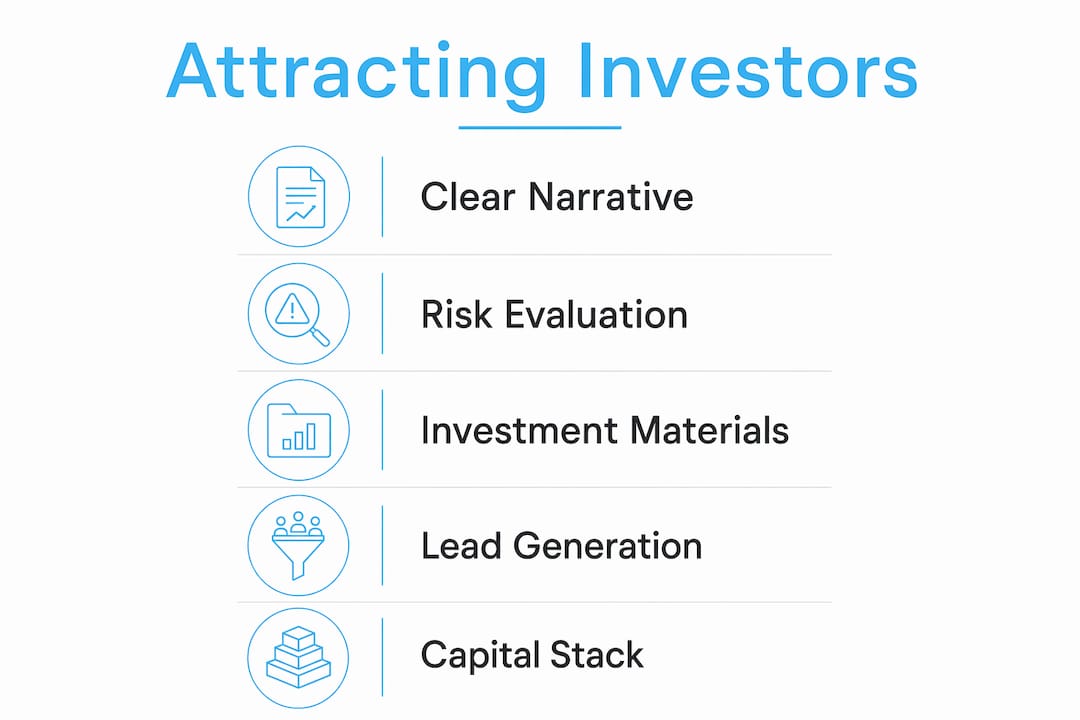
Capital attraction starts early with clear project narratives, strong positioning, and investment-grade marketing materials, well before construction begins. The goal is to make the project tangible and credible before a single shovel touches the ground. Developers who wait until permits are approved to start preparing materials lose months of relationship-building time.
What goes into an investment-grade package
An investor package is not a brochure. It is a structured document that answers every material question an investor will ask, in the order they will ask it. A complete package includes:
- A one-page executive summary with project type, location, total cost, capital structure, and target returns
- A detailed financial model with sensitivity analysis showing downside scenarios
- Site plans, architectural renderings, and BIM content that make the project visually concrete
- A market analysis grounded in comparable sales, absorption rates, and demand drivers
- A risk register that names specific risks and the mitigation strategy for each
- A delivery milestone schedule with clear dates and accountability
Addressing risk proactively and offering clear timelines speeds investor decisions. Investors who feel a developer has hidden or minimised risk will not invest, and they will tell others. Naming risks directly, with solutions attached, is a stronger signal of competence than pretending the risks do not exist.
Visuals and narrative consistency
Renderings and site plans do more than illustrate a project. They reduce the cognitive distance between a spreadsheet and a finished building. A developer presenting a feasibility study alongside high-quality visuals closes that gap faster than financial data alone. TESA’s apartment feasibility service, for example, delivers initial insights within 24 hours, giving developers credible numbers to anchor their investor conversations early.
Consistency across all materials matters as much as quality. If the executive summary describes a boutique residential project and the financial model shows commercial assumptions, investors notice. Every document should tell the same story with the same numbers.
Pro Tip: Have someone outside your team read your investor package before you send it. If they cannot explain the project back to you in two minutes, the materials need more work.
What lead generation strategies work for attracting real estate investors?
Investor lead generation is a long-term, repeatable system requiring consistent communication, precise targeting, and visibility on professional platforms. Developers who treat it as a one-time activity before each project struggle to build momentum. Those who build a system generate qualified interest continuously.
The most effective approach combines four channels:
-
Investor profiling. Define the type of investor your project suits before you start outreach. A high-net-worth individual seeking passive income has different expectations than a family office seeking capital preservation. Matching your messaging to the right profile reduces wasted conversations.
-
Conversion-focused landing pages. A dedicated project page with trust signals, including team credentials, project track record, and a clear call to action, converts interest into registered leads. Generic developer websites do not do this job.
-
LinkedIn outreach and content. LinkedIn remains the most direct channel for reaching accredited investors, family offices, and institutional capital in Canada. Sharing project milestones, market commentary, and development insights builds credibility over time. Outreach messages that reference specific shared interests or connections convert at higher rates than generic pitches.
-
CRM pipeline management. Tracking every investor conversation in a CRM prevents leads from going cold. A developer who follows up consistently and on schedule signals the same discipline investors expect in project delivery.
Paid advertising with retargeting works well for developers who have an existing audience or a specific geographic target. The key is messaging that speaks to investor concerns, not developer pride. “Projected 18% IRR on a fully permitted Toronto infill site” outperforms “exciting new development opportunity” every time.
Content that teaches investors something useful, such as how to read a capital stack or what to look for in a feasibility study, builds trust faster than promotional content. Developers who share project insights consistently attract investors who arrive already educated and already interested.
How to structure your capital stack to attract diverse investors in 2026
The capital stack is not just a financing tool. It is a communication tool. A clearly structured stack tells investors where they sit, what they earn, and what happens if the project underperforms. Developers who explain their stack transparently attract more capital and retain investors across multiple projects.
Matching the capital stack to the business plan timeline and risk profile avoids leverage mismatches. Development deals need lower leverage and thicker equity cushions to absorb execution risk. A stack built for a stabilized asset does not suit a ground-up development.
Preferred equity has grown in use because it adds leverage while remaining acceptable to senior lenders. Sponsors in 2026 focus more on risk management than on optimistic IRR projections. That shift reflects what sophisticated investors now expect: a developer who has stress-tested the model, not one who has polished it.
Sophisticated investors prioritise their position in the repayment waterfall and clawback provisions. Explaining these clearly in your investor materials, including what happens to each capital layer in a downside scenario, builds the kind of trust that generates repeat investment. A table showing each capital layer, its position, its expected return, and its risk profile is one of the most effective pages in any investor package.
Pro Tip: Show a stress-tested scenario in your financial model where revenues come in 15% below projection. If the project still services its debt and returns LP capital, say so clearly. That one page does more for investor confidence than any marketing copy.
Alternative capital providers and soft deposit financing allow developers to secure deals without draining liquidity. In competitive markets like the Greater Toronto Area, the ability to move quickly on a site without committing full deposit capital is a meaningful advantage. It also preserves the liquidity buffer that investors want to see.
What are the most common mistakes when trying to attract investors?
Vague messaging is the most common reason developers fail to attract capital. A project described as “a great opportunity in a growing market” tells an investor nothing. Every project in every pitch sounds like that. Specificity is what separates credible opportunities from noise.
The second most common mistake is ignoring risk in materials. Developers who present only upside scenarios signal either inexperience or dishonesty. Neither builds investor confidence.
Investors do not expect perfection. They expect honesty. A developer who names the risks, explains the mitigations, and shows the downside math earns more trust than one who presents only the best-case scenario. Transparency is not a weakness in investor relations. It is the foundation of every repeat investment.
Inconsistent materials are the third major obstacle. When a pitch deck, a financial model, and a project website tell slightly different stories, investors notice. The discrepancy raises questions about attention to detail and project management capability.
Overcoming these barriers requires a disciplined approach to investor communication. Tailor every message to the specific investor type. A family office conversation is different from a conversation with an accredited individual investor. Generic outreach wastes both parties’ time.
Building long-term investor relationships requires consistent follow-up, even when a project is not actively raising capital. Sharing project milestones and market updates keeps investors engaged between raises. Developers who communicate only when they need money train investors to expect a pitch every time they hear from you.
Key takeaways
Attracting investors to a property development project requires a transparent capital stack, investment-grade materials, and a consistent lead generation system built for the long term.
| Point | Details |
|---|---|
| Capital stack clarity | Present each layer’s position, return, and downside scenario clearly to every investor. |
| Liquidity buffer | Maintain 20–30% more cash than projected costs to reduce investor risk perception. |
| Investment-grade materials | Include a risk register, sensitivity analysis, and high-quality visuals in every investor package. |
| Lead generation system | Use investor profiling, LinkedIn, CRM tracking, and value-first content to build a repeatable pipeline. |
| Transparent communication | Name risks directly and follow up consistently, even between active capital raises. |
How TESA supports developers in attracting investors
TESA is a full-service real estate development firm operating in the Greater Toronto Area, with integrated capital, development, and feasibility divisions built to help developers present credible opportunities to investors.
TESA’s Syndicate Build program is designed for developers who want to structure collective investment vehicles and attract qualified capital partners. For developers earlier in their education, the House Hacking MasterClass provides a foundation in property investment strategy. TESA also delivers development feasibility studies within 24 hours, giving developers the credible financial data they need to anchor investor conversations before committing to a site. Reach out to TESA to learn how their end-to-end approach supports every stage of the capital attraction process.
FAQ
What does attracting investors to a property development project mean?
Attracting investors means presenting a structured, credible opportunity that aligns with investor expectations on risk, return, and timeline. It requires clear materials, a transparent capital stack, and consistent professional communication.
What return do investors expect from a property development project?
Returns vary by position in the capital stack. Senior debt typically yields 6–9%, mezzanine debt 11–15%, preferred equity 11–18%, and sponsor equity targets 15–25%+ IRR in 2026.
How much equity do Limited Partners typically contribute?
In GP-LP structures, Limited Partners typically provide 80–95% of equity capital while General Partners contribute 5–20% and manage the project actively.
What should an investor package include?
A complete investor package includes an executive summary, detailed financial model with sensitivity analysis, site plans, renderings, a market analysis, a risk register, and a delivery milestone schedule.
How do developers build long-term investor relationships?
Developers build lasting relationships by communicating consistently between raises, sharing project milestones and market updates, and following up with tailored messages that match each investor’s profile and priorities.